Patient information
If someone has suggested this treatment to you.
Written for patients, not clinicians
Mytocel MSK uses a small sample of your own cartilage, prepared during the same appointment and administered to a joint. This page explains what that involves and is honest about the limits of what is known.
Please read first
This is general information, not medical advice, and it is not a recommendation that you have this treatment. Whether it suits you depends on your joint, your imaging and your history — things only a qualified clinician who has assessed you can weigh up. Nothing here should replace that conversation, and no one should promise you a particular result.
What it is
Your own tissue, prepared in the room.
“Autologous” means the tissue comes from you. A small amount of cartilage is taken from your ear under local anaesthetic and prepared mechanically into a suspension of tiny cartilage fragments, called micrografts, which is then administered to the joint being treated.
It happens in one appointment. Nothing is donated by anyone else, nothing is grown in a laboratory, and nothing is sent away between visits.
What happens
From assessment to aftercare.
The order matters. An assessment comes first, and it can reasonably end with your clinician telling you this is not the right option for you.
A consultation first
A clinician assesses your joint, your history and your imaging, and tells you whether this pathway is a reasonable option for you at all. Not everyone is suitable, and that conversation comes before anything else.
A small sample from your ear
Under local anaesthetic, three small samples of cartilage are taken from your ear. The tissue is your own, which is what "autologous" means — nothing is donated and nothing is grown in a laboratory.
Prepared in the room, in minutes
The samples are processed mechanically in a single-use device to produce a suspension of cartilage micrografts. This happens during the same appointment rather than being sent away.
Administered to the joint
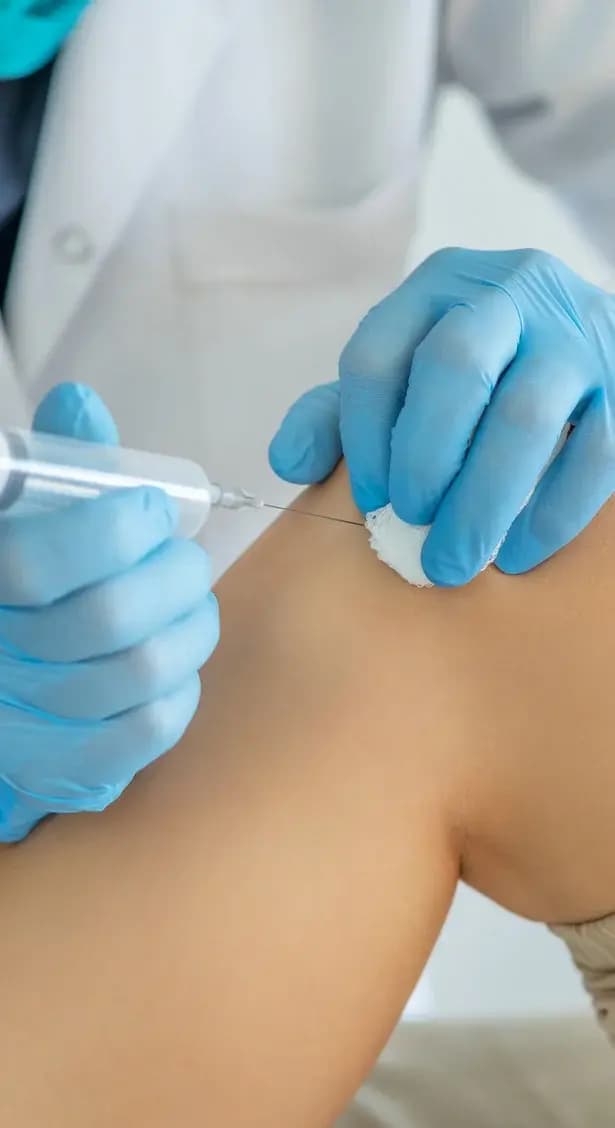
The prepared suspension is administered to the target joint by your clinician, who will then talk you through aftercare and what follow-up looks like.
Being straight with you
What the evidence does and does not show.
Nine publications have been supplied for this technology. It is worth understanding what kind of studies they are before you weigh up what they mean for you.
See the full evidence baseIn short
Small, uncontrolled studies can describe what happened to a handful of people. They cannot tell you how well something works in general, how it compares with the alternatives, or what will happen to you. Anyone presenting them as proof of either is overstating them.
That is not a reason to rule the treatment out. It is a reason to have a careful conversation with your clinician, with the alternatives on the table.
Take this with you
Questions worth asking at your consultation.
You are entitled to clear answers to all of these before you agree to anything. A clinician who is confident in their recommendation will not mind being asked.
Given my imaging and my symptoms, why do you think this is a reasonable option for me?
What are the alternatives, including doing nothing for now, and how do they compare?
What does the evidence actually support for someone in my situation?
What are the risks, the side effects and the recovery like?
What would we do if it does not help?
What will it cost in total, including follow-up?
Finding a clinic
Where to start an assessment.
Actomed supplies and trains UK clinics; it does not assess or treat patients. These are places that can arrange an assessment — being seen at one is not a decision to have any particular treatment.
Lincolnshire · nationwide referrals
MSK Doctors
Assessment and non-surgical musculoskeletal treatment, including cartilage and joint-preservation pathways.
Harley Street, London
London Cartilage Clinic
Cartilage and joint preservation led by Professor Paul Lee, alongside surgical and non-surgical care.
Lincolnshire
Lincolnshire Knee Clinic
One-stop knee clinic with onsite open MRI, for diagnosis before any treatment decision is made.
Not near any of these, or already under the care of a clinician elsewhere? Ask your own clinician first — and if it would help to know which UK clinics offer this pathway, use the form below.
Common questions
Things people ask us.
If your question is about whether this is right for your joint, it belongs with a clinician rather than with us — that is not us deflecting, it is the only place a useful answer can come from.
+Is this treatment available on the NHS?
The clinics currently offering this pathway in the UK are private. Your GP or an NHS specialist can still be part of the conversation, and it is worth asking them what NHS options exist for your joint before deciding.
+Why is cartilage taken from my ear?
Ear cartilage is accessible under local anaesthetic and can be sampled without disturbing the joint being treated. The samples taken are small.
+Is anything grown in a laboratory?
No. The tissue is prepared mechanically during the same appointment. There is no laboratory culture step and nothing is sent away between visits.
+Will it work for me?
Nobody can tell you that, and you should be cautious of anyone who says otherwise. The published studies are small and mostly uncontrolled, so they describe what happened to particular groups of people rather than predicting an individual result. Your clinician can tell you whether you are a reasonable candidate; they cannot promise an outcome.
+Is it a cure for arthritis?
No. Nothing in the supplied evidence supports describing this as a cure, and it should not be presented to you that way.
+Can Actomed tell me whether I should have this?
No, and it would not be appropriate for us to try. Actomed supplies the product to clinics and trains their teams — we have never seen your imaging and we are not a clinical service. Whether this pathway suits you is a question for a qualified clinician who has assessed you.
+Who decides if I am suitable?
The clinician assessing you. Suitability depends on your joint, your imaging, your history and what else has already been tried.
Get in touch
Not sure where to be seen?
Tell us roughly where you are and we will point you towards a UK clinic offering this pathway. We will not ask you for medical details, and we cannot advise you on your own case.
If you are a clinician rather than a patient, the professional section is here